
Maison > Nouvelles > Yes, a puzzle game that tests physics skills is a fantastic concept and quite common in both casual and educational gaming! These games typically challenge players to use principles of real-world physics—like gravity, momentum, friction, collision, balance, and trajectory—to solve puzzles and progress through levels. Here’s a breakdown of how such a game might work and what it tests: 🎮 Common Physics Puzzle Game Examples: World of Goo – Build structures using goo balls, obeying gravity, tension, and structural integrity. Cut the Rope – Use gravity, rope physics, and object interactions to feed candy to a monster. Angry Birds – Launch birds with trajectory and momentum to knock down structures (Newtonian physics). The Talos Principle (partially) – Uses environmental puzzles involving levers, gravity, and object interaction. Human: Fall Flat – Emphasizes ragdoll physics and problem-solving with body movement and physics-based mechanics. Tumble Fever (mobile) – Stack blocks and balance under gravity to reach the goal. 🧠 What Physics Skills Are Tested? These games typically assess and develop: Gravity and motion – Understanding how objects fall, bounce, or move through space. Trajectory and projectile motion – Predicting where an object will land when launched. Balance and center of mass – Building stable structures or preventing tipping. Collision and momentum transfer – Predicting how objects react when they hit each other. Friction and resistance – How much force is needed to move something. Pulley, lever, and gear mechanics – In more advanced puzzles. ✅ Why It’s Great for Learning: Engaging education: Teaches physics concepts in a fun, hands-on way. Problem-solving under constraints: Encourages trial-and-error, critical thinking, and spatial reasoning. Immediate feedback: Players see the results of their decisions in real time. 🛠️ Game Design Tips for a Physics Puzzle Game: Use realistic physics engines like Box2D, Unity’s Physics Engine, or Godot Physics. Introduce mechanics gradually (e.g., start with gravity, then add springs, magnets, or fluids). Include visual cues (e.g., velocity arrows, force lines) to help players understand physics. Add "Eureka!" moments when players discover a clever solution. 🎯 Example Game Concept: Title: Balance Zone Premise: You’re a scientist in a zero-gravity lab. Your goal: guide a ball through a maze by adjusting rotating platforms, using gravity, momentum, and object collisions. Physics Skills Tested: Launch angle and velocity Bouncing and elasticity Rotational momentum Collision timing Would you like help designing a physics puzzle game concept, testing a mechanic, or writing a simple prototype (e.g., in Unity or Scratch)? I can help with that too!
Yes, a puzzle game that tests physics skills is a fantastic concept and quite common in both casual and educational gaming! These games typically challenge players to use principles of real-world physics—like gravity, momentum, friction, collision, balance, and trajectory—to solve puzzles and progress through levels. Here’s a breakdown of how such a game might work and what it tests: 🎮 Common Physics Puzzle Game Examples: World of Goo – Build structures using goo balls, obeying gravity, tension, and structural integrity. Cut the Rope – Use gravity, rope physics, and object interactions to feed candy to a monster. Angry Birds – Launch birds with trajectory and momentum to knock down structures (Newtonian physics). The Talos Principle (partially) – Uses environmental puzzles involving levers, gravity, and object interaction. Human: Fall Flat – Emphasizes ragdoll physics and problem-solving with body movement and physics-based mechanics. Tumble Fever (mobile) – Stack blocks and balance under gravity to reach the goal. 🧠 What Physics Skills Are Tested? These games typically assess and develop: Gravity and motion – Understanding how objects fall, bounce, or move through space. Trajectory and projectile motion – Predicting where an object will land when launched. Balance and center of mass – Building stable structures or preventing tipping. Collision and momentum transfer – Predicting how objects react when they hit each other. Friction and resistance – How much force is needed to move something. Pulley, lever, and gear mechanics – In more advanced puzzles. ✅ Why It’s Great for Learning: Engaging education: Teaches physics concepts in a fun, hands-on way. Problem-solving under constraints: Encourages trial-and-error, critical thinking, and spatial reasoning. Immediate feedback: Players see the results of their decisions in real time. 🛠️ Game Design Tips for a Physics Puzzle Game: Use realistic physics engines like Box2D, Unity’s Physics Engine, or Godot Physics. Introduce mechanics gradually (e.g., start with gravity, then add springs, magnets, or fluids). Include visual cues (e.g., velocity arrows, force lines) to help players understand physics. Add "Eureka!" moments when players discover a clever solution. 🎯 Example Game Concept: Title: Balance Zone Premise: You’re a scientist in a zero-gravity lab. Your goal: guide a ball through a maze by adjusting rotating platforms, using gravity, momentum, and object collisions. Physics Skills Tested: Launch angle and velocity Bouncing and elasticity Rotational momentum Collision timing Would you like help designing a physics puzzle game concept, testing a mechanic, or writing a simple prototype (e.g., in Unity or Scratch)? I can help with that too!
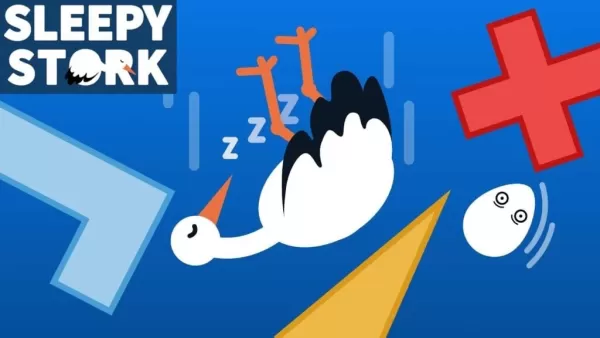
Sleepy Stork: A Whimsical, Wacky Puzzle Adventure Arrives on Android
By [Your Name], Game Reviewer
If you’ve ever wondered what happens when a sleepy stork takes a nap mid-migration and wakes up in a world where physics, dreams, and absurdity collide — Sleepy Stork is the game for you. Released today on Android by indie studio Moonstripes (known for Window Wiggle, Butterfly Surprise, Dots and Bubbles, and Human Flag), this delightful physics-based puzzler is equal parts zen, zany, and oddly insightful.
🌙 The Premise: A Bird’s Nap, A World of Wonders
You play as a large, lovable stork who dozes off during its seasonal flight south. In the blink of an eye, it's no longer soaring through the sky — it’s falling, drifting, and completely out of control. Your mission? Guide this sleeping bird gently to its cozy nest using clever taps, environmental interactions, and a healthy dose of chaos.
With over 100 levels, each stage builds on the last, introducing new mechanics like moving platforms, bouncing blocks, gravity shifts, and oddly shaped obstacles. Some levels test your timing, others your spatial reasoning — and a few will test your patience (and sense of humor).
🎮 How It Plays: Simple, Satisfying, and Surprisingly Deep
- Tap to interact: Push, drop, or trigger objects to create paths.
- Use physics to your advantage: Bounce off trampolines, slide down ramps, or use wind gusts to nudge the stork into place.
- Dream logic rules: Some levels require you to think outside the box — or at least, outside reality.
The gameplay is intuitive but gets increasingly intricate. Early levels ease you in with gentle slopes and soft landings. But by level 15, you’re juggling rotating platforms, collapsing bridges, and — yes — a surprise avalanche of marshmallows.
And then there’s the dream sequences.
🌈 Dream Logic: Where Puzzles Meet Psyche
Each time Sleepy Stork lands safely in its nest, it drifts into a surreal dream world — and each dream comes with a quirky interpretation.
Did you know:
- Dreaming of a lion? You’re facing inner conflict or a looming challenge.
- A toilet in your dream? It might be time to “let go” of emotional baggage.
- A flying turtle? Possibly your subconscious is saying, “Slow down, you’re moving too fast!”
These dream notes aren’t just flavor text — they’re part of the game’s charm. They turn each level into a mini-meditation on emotions, fears, and the weirdness of the subconscious. It's like LSD meets The Sims* with a dash of Carl Jung.
😂 Comedy Meets Chaos: The Ragdoll Stork
Let’s talk about the stork’s sad, floppy fall through a world full of madcap mechanics. Thanks to the game’s loose physics engine, your bird often becomes a ragdoll of absurdity — flailing, spinning, and getting tossed like a feather in a blender.
There’s a moment in level 37 where the stork gets launched from a spring, bounces off a spinning windmill, and lands… on a floating cloud wearing a tiny paper hat. You’ll laugh. Then you’ll try to recreate it. Then you’ll fail. Then you’ll try again.
It’s glorious.
📱 Why You Should Download It (And Why It’s Free)
- ✅ Free to play — with no paywalls or forced ads (at least, not yet).
- ✅ Cute, hand-drawn art style with soft pastels and expressive animation.
- ✅ Perfect for short bursts — great for commuting, coffee breaks, or unwinding before bed.
- ✅ A refreshing break from grindy puzzle games — no timers, no lives, no stress.
📺 Watch the Magic in Action
Check out the official trailer below — and prepare to be delighted:
🔗 Ready to Dream?
👉 Download Sleepy Stork for free on the Google Play Store now.
And if you’re craving more nostalgia with a modern twist, don’t miss our coverage of the Reforged Edition of Broken Sword: Shadow of the Templars — coming to mobile, reborn for a new generation of adventurers.
Final Verdict:
Sleepy Stork isn’t just a game — it’s a lullaby for your brain, a giggle for your soul, and a dreamy puzzle journey you won’t want to wake up from. 9/10 — definitely worth a nap. 😴🐦💤













-
1
Chaque jeu Pokémon sur le Switch Nintendo en 2025
Feb 25,2025
-
2
Stardew Valley: un guide complet des enchantements et du forgeage d'armes
Mar 17,2025
-
3
![Anime Vanguards Tier List - Meilleures unités pour chaque GameMode [Update 3.0]](https://images.gzztb.com/uploads/35/17376012656791b0f12fa1c.jpg)
Anime Vanguards Tier List - Meilleures unités pour chaque GameMode [Update 3.0]
Feb 27,2025
-
4
Ragnarok X: Next Gen - Guide d'enchantement complet
May 25,2025
-
5
Poring Rush, le spin-off décontracté du MMORPG à succès Ragnarok Online, est maintenant disponible
Dec 30,2024
-
6
ROBLOX: CODES DE TRUCKING EMPIRE (janvier 2025)
Mar 05,2025
-
7

NVIDIA RTX 5090 Spécifications fuites: rumeur confirmée?
Mar 14,2025
-
8
Comment lire Black Panther Lore: The Blood of Kings in Marvel Rivals
Mar 01,2025
-
9
Microsoft pour intégrer Copilot Ai dans les applications et les jeux Xbox
May 21,2025
-
10
Hearthstone a lancé l'année du Raptor avec une myriade de nouveaux contenus
Mar 16,2025
-
Télécharger

The Golden Boy
Occasionnel / 229.00M
Mise à jour: Dec 17,2024
-
Télécharger

Niramare Quest
Occasionnel / 626.43M
Mise à jour: Feb 21,2023
-
Télécharger

Mother's Lesson : Mitsuko
Jeu de rôle / 716.30M
Mise à jour: Dec 14,2024
-
4
POW
-
5
Gamer Struggles
-
6
How To Raise A Happy Neet
-
7
Poly Pantheon Chapter One V 1.2
-
8
Dictator – Rule the World
-
9
Strobe
-
10
Livetopia: Party